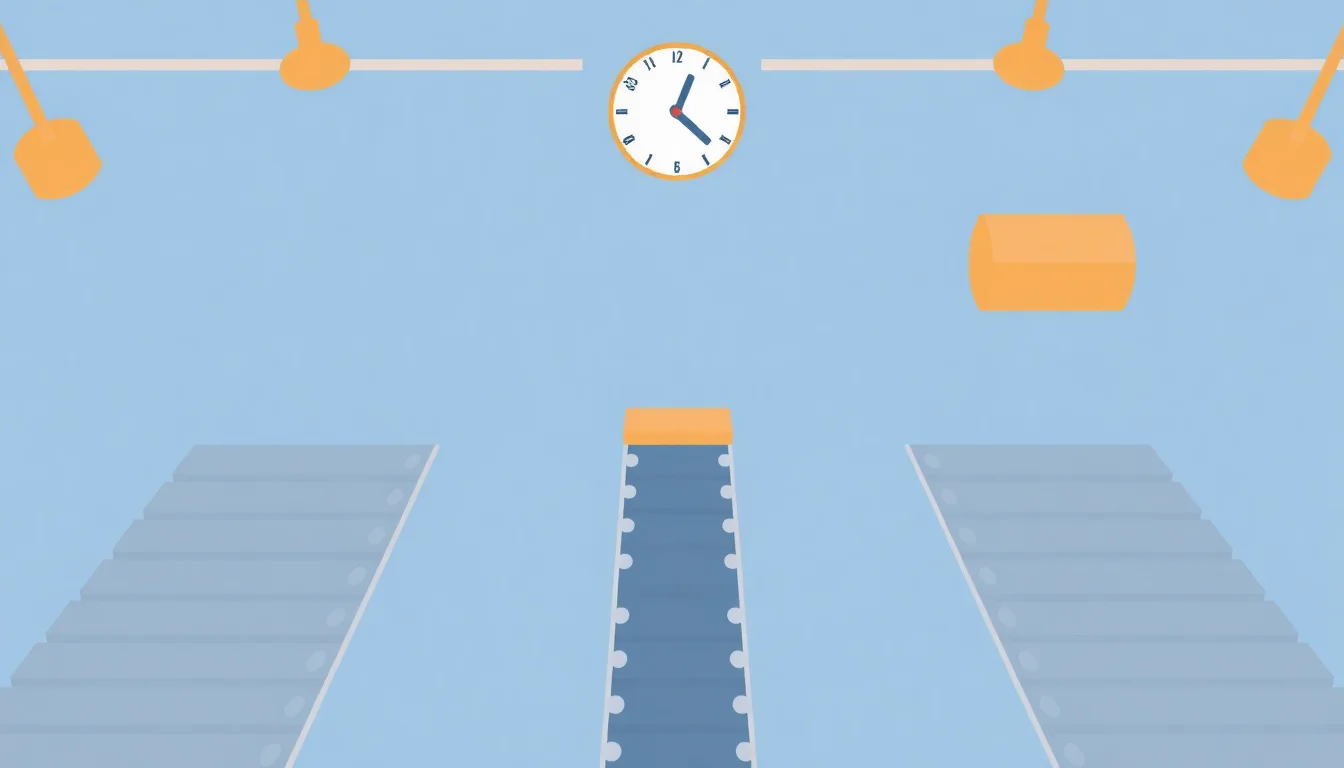
Production lines start late every morning because no single system connects attendance data, line readiness, and shift start compliance in real time. Supervisors rely on visual checks and gut feel, not data. A 15-minute daily delay across two shifts and 250 workdays costs the equivalent of 125 fully lost production hours per line per year, and most operations never measure it.
The Anatomy of a 15-Minute Late Start: What's Actually Happening on the Floor
Late starts are rarely one failure. They are a chain reaction. A missing temp worker triggers a floor walk. The floor walk delays pre-checks. Pre-checks incomplete means the line launch is pushed. By the time the supervisor resets, 15 minutes are gone.
In beauty contract manufacturing and light industrial environments, this chain is especially fragile. Temp labor variability adds an unpredictable layer: workers who don't know the line, the product, or the startup sequence slow everything down before the first unit is even produced. Shift startup compliance becomes a daily gamble rather than a managed process.
The deeper problem is structural. The 15-minute window gets treated as an informal grace period, not a tracked operational metric. Without a trigger system connected to real-time labor data, late starts normalize within weeks. Nobody flags them. Nobody fixes them. They simply become the new definition of "on time."
The Five Root Causes That Delay Line Startup Every Morning
Pinpointing root cause is the first step toward eliminating chronic delays. These five causes appear consistently across mid-market contract manufacturing and 3PL operations:
-
Attendance uncertainty. Supervisors don't know who's present until they physically walk the floor. A clock-in at the building entrance tells you nothing about whether that worker reached their assigned line.
-
Material and consumable gaps. Packaging components, formulas, or supplies not staged before shift means someone runs to retrieve them after the bell. Seconds become minutes.
-
Equipment readiness failures. CIP cycles, calibration tasks, or changeover work from the prior shift left incomplete pushes the startup sequence past the scheduled window.
-
Staffing handoff failures. Temp labor assignments communicated late or incorrectly to line leads create last-minute scrambles that cascade across multiple lines simultaneously.
-
Supervisor overload. A single supervisor managing three to five lines cannot execute a structured startup sequence across all of them at once. Something always slips.
Manufacturing employer compensation costs averaged $46.30 per hour in June 2025 (bls.gov). Every minute of delay carries a real dollar value. The question is whether your operation is measuring it.
Why Experienced Supervisors Stop Flagging the Problem
Once a 15-minute late start becomes the norm, supervisors mentally adjust their benchmark. What was once late becomes "on time enough." This is human nature, not negligence.
Without a reporting system that captures actual start time versus scheduled start time, there is no feedback loop. Supervisors who flag chronic issues without supporting data are often dismissed. The absence of visibility is self-reinforcing: no data means no accountability, which means no pressure to change. The problem hides in plain sight.
Calculating the True Annual Cost of Production Line Start Delays
Cost visibility is what transforms this from an operational annoyance into a board-level concern. The math is straightforward once you use the right inputs.
The Cost Calculation Most Operations Teams Are Missing
Most operations teams stop at base wage when estimating delay cost. That's the wrong number. Use fully-loaded labor cost, which includes wages, benefits, and temp agency markup.
Here is the framework:
- Step 1: Multiply (daily delay in hours) x (number of workers on line) x (fully-loaded hourly rate)
- Step 2: Multiply by annual shift days and number of affected lines
- Step 3: Add throughput opportunity cost: units not produced x contribution margin per unit
- Step 4: Add downstream cascade costs: overtime triggered, expedite fees, and any customer SLA penalties
Let's walk through a concrete example. Consider a beauty contract manufacturer running 10 lines, each with 20 workers, experiencing a 15-minute delay per shift across 500 annual shifts. Using $46.30 per hour as the manufacturing employer cost (bls.gov), the direct labor waste alone reaches approximately $578,750 per year. Add throughput loss and overtime premiums, and the total figure climbs well past that.
The hidden multiplier deserves attention. Late starts push all downstream production targets, increasing the probability of overtime, expediting costs, and missed service-level agreements. The 15-minute delay at 6:00 AM becomes the missed shipment at 5:00 PM.
Why ERP and MES Systems Miss This Cost Entirely
This is the core blind spot. MES systems capture machine uptime and batch start times, but the timestamp begins when an operator logs into the machine, not when the shift was scheduled to begin. ERP systems record labor hours against work orders but have no mechanism to flag that those hours started 15 minutes late.
The gap between scheduled start and actual start lives in no system. It is absorbed silently into labor variance analysis that finance cannot explain. Operations leaders reviewing labor variance reports see the symptom but never the cause. Workforce intelligence platforms exist specifically to close this gap.
How Production Line Start Delays Stay Invisible: The Visibility Gap in Workforce Data
Most manufacturers run three disconnected data sources: timekeeping, MES, and scheduling. None of them talk to each other in real time. The gap between "worker present" and "line running" is never captured by any of them individually.
This matters. Here's why.
The Three Data Silos That Create the Blind Spot
Silo 1: Timekeeping and Attendance. Confirms a worker clocked in. Does not confirm they reached their assigned line and were ready to run. Building entry and line readiness are not the same event.
Silo 2: MES and Production Systems. Records when a work order or batch was started. Does not capture the delta between scheduled and actual start. The system sees a clean start; the floor experienced a chaotic one.
Silo 3: Staffing and Scheduling. Shows who was assigned. Does not show who showed up, who was reassigned at the last minute, or whether a temp worker had the right skills for the line they were placed on.
The intersection of these three silos, where the late start actually lives, exists in no current system for most mid-market manufacturers. Staffing agencies often provide headcount data on a daily or weekly lag, making real-time line readiness assessment structurally impossible without a dedicated workforce intelligence layer sitting above and between these systems.
Why "We Track It in Our ERP" Is Not the Same as Workforce Visibility
ERP labor modules are designed for payroll accuracy and cost allocation. They are not built for real-time operational decision-making. An ERP can tell you how many hours were charged to a work order. It cannot tell you the line was idle for the first 15 minutes of every shift.
Workforce intelligence platforms connect existing systems with a data layer that captures timing and performance data that ERP and MES were never designed to track. The goal is not replacement. It is connection. Real-time labor data flowing between systems gives operations managers the production line visibility they currently lack.
Operational Fixes That Actually Work: Eliminating Late Starts with Workforce Intelligence
The most effective interventions combine a real-time data trigger with a clear accountability owner. A policy memo changes nothing. A system that alerts a supervisor at T+5 minutes past scheduled start changes behavior on the first day it goes live.
At Elements Connect, we consistently find that the operations teams making the fastest progress are the ones who treat late-start data as a coaching tool rather than a compliance stick. Our team has found that this approach, combined with real-time workforce intelligence, delivers measurable results within the first month of implementation. The data reveals obstacles. Supervisors remove them. Lines run on time.
The Four-Step Framework to Eliminate Chronic Late Starts
Step 1: Measure. Deploy a workforce intelligence layer that captures actual line start time versus scheduled start time, by line, by shift, and by supervisor. You cannot manage what you cannot see.
Step 2: Alert. Configure automatic escalation when a line is not confirmed running within five minutes of scheduled start. Proactive alerting turns a chronic pattern into a solvable incident.
Step 3: Attribute. Tag late starts with a root cause code: attendance, material, equipment, or staffing. Incident tracking without categorization produces reports nobody can act on. Pattern analysis does.
Step 4: Act. Use weekly trend data in shift startup reviews to drive Kaizen-style continuous improvement with the floor team. A Kaizen approach to food manufacturing reduced operational costs by 10% and increased production efficiency by 15% in a documented case study (flevy.com). The same discipline applied to shift startup compliance produces measurable results on a similar timeline.
Real-time scheduling and alerting systems produce results in adjacent environments as well. Retail operations using real-time scheduling updates reduced overtime by 72% (timeforge.com). The principle transfers directly to manufacturing shift startup management.
What Good Looks Like: Leading Indicators for Line Startup Performance
Define your targets before you instrument your measurement. These are the KPIs that matter for shift startup compliance:
For staffing agencies, providing clients with real-time labor data tied to their worker placements transforms a commodity relationship into a strategic partnership. Temp labor performance data is a retention tool that most agencies do not yet offer.
Building a Culture Where Late Starts Are Visible, Measurable, and Preventable
Technology surfaces the data. Culture determines whether anything changes. Both are required.
Floor-level buy-in requires framing late-start data as a tool for the supervisor, not a surveillance mechanism against them. The difference in framing determines whether adoption succeeds or fails within the first 30 days.
How to Introduce Startup Visibility Without Creating a Culture of Blame
Start with the right language. Frame the initiative as removing the obstacles that cause late starts, not catching supervisors who let lines run late. These are genuinely different conversations, and people on the floor can tell which one you're having.
Involve line leads in designing the startup checklist and defining what "ready to run" means for each line type. When the people closest to the problem help design the solution, adoption follows naturally.
Use aggregate trend data in team reviews before surfacing individual-level data. In our experience, this phased approach to data transparency builds supervisor confidence in the system and accelerates adoption across multiple production sites. Build trust in the system before using it for performance conversations. Kaizen-inspired daily startup reviews, 15-minute stand-ups using the prior day's start compliance data, create rapid feedback loops without bureaucracy. A Kaizen strategy that produced a 20% reduction in lead times in one manufacturing case study (flevy.com) used exactly this kind of structured review cadence.
Celebrate improvements publicly. A line that cut its average late start from 18 minutes to two minutes is a win worth recognizing at the shift meeting. Accountability paired with recognition drives sustainable behavior change. Organizations that embed startup compliance into their operational scorecard, reviewed at the VP or Plant Manager level, see the fastest improvement at the line level.
Overall Labor Effectiveness improves when the workforce variable is finally measured with the same rigor as machine uptime. Labor variance analysis becomes actionable when it reflects timing, not just hours. The invisible becomes visible. And visible problems get solved.
Frequently Asked Questions
What is a 'production line start delay' and how is it formally defined for measurement purposes?
How much does a 15-minute daily production line delay cost annually across a multi-line facility?
Why don't MES or ERP systems catch production line start delays automatically?
What's the difference between a workforce intelligence platform and a standard timekeeping or scheduling system?
How can plant managers create accountability for line startup performance without demoralizing supervisors?
Can staffing agencies be held accountable for production line start delays caused by their workers?
What KPIs should a VP of Operations track to monitor and reduce shift startup delays?
How long does it typically take to see measurable improvement in line startup times after implementing a workforce intelligence solution?
Sources & References
- Employer Costs for Employee Compensation, September 2025 - Bureau of Labor Statistics (opens in a new tab)[gov]
- Kaizen Strategy Case Study: Mid-Size Food Manufacturing Company - Flevy (opens in a new tab)[industry]
- The Importance of Real-Time Updates in Employee Scheduling - TimForge (opens in a new tab)[industry]
About the Author
Elements Connect
Elements Connect is a workforce intelligence platform helping beauty contract manufacturers, 3PLs, and staffing agencies transform disconnected labor data into actionable insights that reduce costs and elevate operational performance.
Learn more at elementsconnect.com → (opens in a new tab)Related Posts

How Staffing Agencies Can Build a Proprietary Talent Quality Score Clients Can't Get Anywhere Else
Most staffing agencies compete on price and speed—but neither creates lasting client loyalty. A proprietary Talent Quality Score built from real performance data changes the conversation entirely. Here's the step-by-step framework for building one your clients can't find anywhere else.
10 min read
Your Best Operators Are Carrying Your Worst Ones: How to Use Per-Worker Performance Data to Fix Line Imbalance
When your fastest operators compensate for your slowest ones, line imbalance becomes invisible—until it shows up in your labor cost per unit. This guide shows plant managers and operations leaders how to use per-worker performance data to surface hidden imbalance, reassign talent strategically, and build a continuous improvement culture that scales.
15 min read
Why Display Manufacturers Keep Getting Labor Wrong (It's Not What You Think)
Display manufacturers consistently mismanage labor for one structural reason: every tool they have was built for a different kind of factory.
4 min read