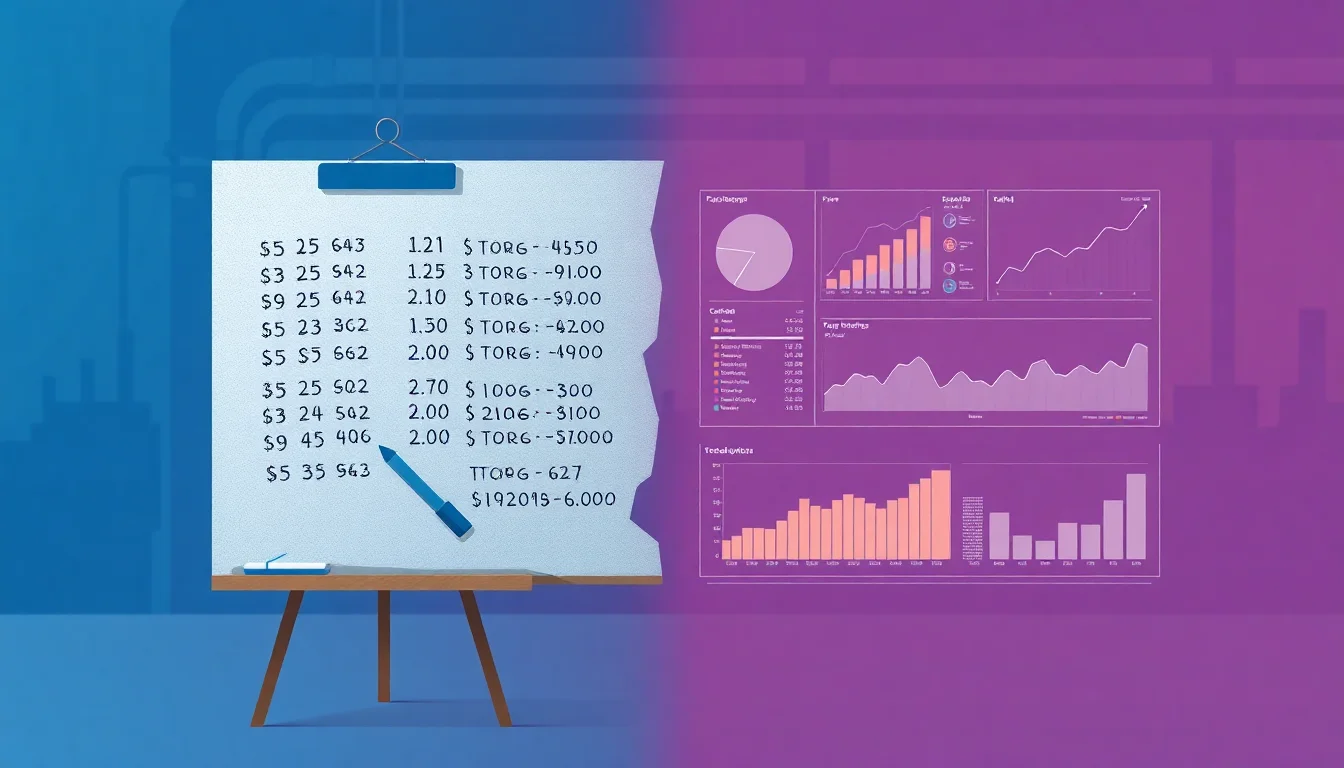
Whiteboard production logging hides shift-level labor variance, per-unit labor costs, and staffing performance data that directly impact your bottom line. Without digital capture, manufacturers lack real-time visibility into workforce decisions driven by labor performance, making cost reduction, accountability, and demand-scaling nearly impossible to execute with confidence.
What Whiteboard Production Logging Actually Captures, and What It Misses
A whiteboard records a number. That's it. It captures completed units at a point in time but cannot show why output changed, which worker or line drove the variance, or what happened in between entries. The gap between what gets written on the wall and what actually occurred on the floor is where your operational intelligence disappears.
Over 45% of business processes remain paper-based (deep-analysis.net), and production floors are no exception. Manual entries are subject to transcription errors, end-of-shift memory gaps, and selective recording by supervisors who are already stretched thin. When data lives on a wall, it cannot be aggregated across lines, compared across shifts, or fed into MES ERP integration workflows without someone re-entering it manually. That re-entry introduces another layer of error.
Supervisors hired to manage floor performance spend material portions of their shifts transcribing numbers instead. That's a structural misallocation that whiteboards make invisible.
The Gap Between What You Record and What Actually Happened
Whiteboards capture completed units. They do not capture micro-stoppages, the brief but frequent interruptions that collectively account for significant capacity loss across a shift. These events, a jammed line, a late material hand-off, a worker called to cover another station, rarely make it onto the board. They evaporate. But they accumulate. Across a full production year, untracked micro-stoppages represent a meaningful slice of capacity that never gets recovered because it never gets diagnosed.
Shift handoffs worsen the problem. When incoming supervisors receive a verbal briefing or scan a whiteboard, they inherit a summary, not a record. Critical context about why output dropped, which workers underperformed, or what equipment contributed to a slowdown is lost at the transition point. The next shift starts from zero, repeating preventable errors because there is no structured data infrastructure to flag them.
Without timestamped digital records, post-shift analysis is not just difficult. It is impossible.
Why Beauty Contract Manufacturing and 3PL Operations Are Most Exposed
Beauty contract manufacturing operates with high SKU variability and frequent changeovers. Each changeover is a potential data dead zone. When a line switches formulations or packaging formats, the whiteboard gets a new tally, but nothing captures the time lost, the rework rate, or which temp workers were on the line during the transition.
3PL labor management compounds this problem. Fluctuating headcount from multiple staffing agencies means there is no consistent baseline to measure against. Client SLA reporting built on whiteboard data creates legal and contractual risk. When a client challenges the numbers, there is no audit trail. That exposure is real, and it grows with every contract renewal.
The Hidden Labor Cost Blind Spots Created by Manual Production Logging
Labor is typically the largest variable cost in contract manufacturing. Without per-shift, per-line labor data, you cannot calculate true labor cost per unit or Overall Labor Effectiveness. You are managing your biggest cost driver with one eye closed.
Overstaffing and understaffing decisions made without real-time labor visibility create chronic cost inflation. They will wait for the end-of-week summary, by which time the opportunity to intervene has passed. Manual logs lead directly to this pattern: monthly or weekly reviews where fix opportunities have already expired.
Temp labor performance variance is equally invisible. On a whiteboard, a staffing agency that delivers high-performing workers looks identical to one that consistently sends workers who underperform. Both show up as headcount. Staffing ROI cannot be quantified without output data tied to individual workers or agency cohorts.
Why Labor Remains the Most Expensive and Least Optimized Variable
MES and ERP systems are designed to track machines, materials, and inventory. They are not built to capture human performance at the shift and line level. The workforce variable is systemically excluded from operational intelligence in most mid-market manufacturers. This exclusion means Industry 4.0 investments deliver only partial ROI. Digital thread and traceability initiatives that cover equipment and materials but ignore workers create a data record with a significant gap at its center.
The operational consequence is structural. Finance and operations teams work from different datasets. Finance sees labor hours and wages. Operations sees unit counts. Neither team can reconcile those numbers to a cost-per-unit figure without manual analysis that is rarely done consistently.
Staffing Agency Performance: The Data That Never Gets Captured
This is where the blind spot becomes a competitive liability. Staffing agencies serving manufacturing clients invest in recruiting, screening, and placing workers. When production data lives on whiteboards, there is no mechanism to compare output per temp worker by staffing partner. An agency that consistently delivers higher-performing workers has no data to prove it. They compete on price because quality cannot be demonstrated.
Client retention suffers when staffing ROI cannot be quantified. The relationship becomes transactional. That dynamic hurts both sides, and it originates entirely from a data capture failure at the production floor.
How Data Visibility Gaps Compound Across Shifts, Lines, and Facilities
A single shift's whiteboard data cannot be benchmarked against prior shifts without manual compilation. That compilation rarely happens with the consistency needed to generate reliable trends. Across a multi-line or multi-facility operation, the compounding effect is severe. Each additional line or site multiplies the volume of unstructured, non-comparable data.
Seasonal demand spikes in beauty manufacturing expose this compounding dynamic in real time. More lines running, more temp workers on the floor, and less visibility into how any of it is performing. Continuous improvement manufacturing initiatives fail in this environment. Kaizen requires a baseline. You cannot improve what you cannot measure consistently.
Shift Handoffs and the Data Dead Zone
The shift handoff is the highest-risk moment in any production day. Critical performance context, why output dropped, which workers underperformed, what equipment contributed, evaporates at the transition. Incoming supervisors start each shift without actionable intelligence. They rely on what the outgoing supervisor remembers to share, which is filtered, incomplete, and unreliable.
The cumulative cost of these dead zones across a full production year is rarely calculated but consistently significant. Operations leadership making decisions on capacity, hiring, and scheduling based on anecdote and intuition are, in effect, flying without instruments.
Why Cross-Facility Comparisons Are Impossible Without Digital Capture
Manufacturers operating multiple sites cannot identify which facility runs the most efficient labor model without unified shift performance data. Best practices developed organically at one facility never surface or transfer without a structured data infrastructure to make them visible. The high-performing line at Plant A never becomes a template for Plant B because no one can prove it is high-performing with consistent, comparable data.
Clients and contract partners increasingly expect performance transparency. Whiteboard operations cannot provide it. This is becoming a procurement and retention risk, not just an internal inefficiency.
What Workforce Intelligence Platforms Reveal That Whiteboards Cannot
Digital production logging with workforce data capture changes the operational picture fundamentally. Real-time labor visibility ties output rates to specific workers, shifts, lines, and staffing partners. That connection is what makes labor cost per unit a trackable KPI rather than an estimate.
Manufacturers who have adopted smart manufacturing tools report a 10% to 20% improvement in production output and a 7% to 20% improvement in employee productivity (deloitte.com). The same research found 10% to 15% in unlocked capacity (deloitte.com). These are not vendor benchmarks. They reflect outcomes reported by operations leaders who made the transition.
Real-time dashboards also change the Mean Time to Repair dynamic. When a workforce intelligence platform captures timestamped production events, supervisors can identify the moment output began declining and correlate it with a specific labor or equipment event. Without that historical data, the root cause analysis that follows a production failure is guesswork. With it, the diagnosis is faster and the fix is targeted.
From Gut Feel to Data-Driven Labor Strategy
At Elements Connect, we consistently see the same pattern when manufacturers move from whiteboard logging to digital workforce analytics: supervisors describe it as getting their job back. They were hired to manage floor performance. Manual transcription was getting in the way.
Workforce intelligence platforms replace anecdotal performance reviews with objective, timestamped output data. At Elements Connect, we have helped manufacturers move beyond these anecdotal reviews by capturing timestamped production events that tie output directly to labor inputs, making OLE metrics measurable and labor cost per unit improvable. OLE metrics become measurable. Labor cost per unit becomes improvable. Scheduling decisions move from intuition to pattern recognition. The shift is not incremental. It is structural.
Consider a mid-size beauty contract manufacturer running three production lines with seasonal headcount that doubles between Q3 and Q4. In our experience working with similar operations, manufacturers that implement digital workforce analytics can model labor demand against historical shift performance data and identify high-performing staffing partners from prior peaks, replacing Q4 guesswork with data-driven ramp planning. Without digital capture, the Q4 ramp is managed on feel: hire more, hope for the best, review the numbers in January. With a workforce intelligence platform in place, that manufacturer can model labor demand against historical shift performance data, identify which staffing partners performed during the prior Q4 surge, and build a ramp plan tied to actual output baselines. The difference in outcome is measurable from the first seasonal cycle.
Building Accountability Without Replacing Your Existing Systems
The most common objection operations leaders raise is displacement risk. They assume digital workforce analytics means replacing the MES or ERP they have spent years configuring. It does not. Modern workforce intelligence platforms are designed to layer on top of existing systems. Data flows are additive. The platform captures what the MES and ERP miss, specifically the human performance variable, and surfaces it in a format that integrates with existing operational workflows.
Floor-level adoption improves when tools reduce burden rather than adding reporting steps. Workers and supervisors who see their own performance data used transparently and fairly engage with the system. Transparency drives engagement. That is not a soft outcome. It is a measurable adoption driver.
Worth noting: 78% of manufacturers now allocate more than 20% of their improvement budget toward smart manufacturing initiatives (deloitte.com), and 51% report that these initiatives are owned and driven by operations leaders (deloitte.com). The operational case for workforce analytics is being made at the VP and Plant Manager level, not just in the IT department.
Making the Transition: How to Move from Whiteboard Logging to Real-Time Data Visibility
Start with a visibility audit. Map every point where production data is currently captured, transcribed, or lost. This audit typically surfaces three to five critical gaps that are costing the operation real money and that digital capture can close immediately.
Identify the highest-cost blind spots first. These are usually the shifts, lines, or facilities with the most temp labor variance and the least consistent output data. Starting here ensures that the initial implementation generates measurable ROI quickly, which builds internal momentum for broader rollout.
Choose a phased implementation tied to a non-peak production period. Establish baseline OLE and labor cost-per-unit metrics before go-live so you have a clean before/after comparison. That comparison is what justifies the next phase of rollout to leadership.
Prioritizing Quick Wins to Build Internal Momentum
Focus initial digital logging on one or two production lines with the highest labor cost variance. Surface one actionable insight within the first 30 days. A single scheduling optimization or staffing reallocation that demonstrably improves shift output is enough to shift organizational perception from skepticism to interest.
Only 32.5% of manufacturers currently engage third parties for change management support during smart manufacturing rollouts (deloitte.com). That gap is where implementations stall. Involve floor supervisors and team leads in tool selection and rollout from the start. Their buy-in is not optional. It is the implementation.
What Good Data Governance Looks Like on the Production Floor
Define ownership before go-live. Who enters data, who reviews it, who escalates anomalies at the shift, line, and facility level? Without clear ownership, data quality degrades and the platform loses credibility with the leadership teams who rely on it.
Establish data quality standards so workforce performance metrics are comparable across shifts and sites. Create a simple feedback loop so floor workers understand how their performance data is used. This transparency is what converts compliance into engagement. Results speak louder than any rollout communication.
Frequently Asked Questions
What are the biggest risks of using whiteboards for production logging in contract manufacturing?
How does manual production logging affect labor cost visibility and Overall Labor Effectiveness (OLE)?
Can workforce intelligence platforms integrate with existing MES and ERP systems without disrupting operations?
How do staffing agencies benefit from digital production logging and workforce performance data?
What is the typical ROI timeline for replacing whiteboard production tracking with a digital workforce intelligence platform?
How does real-time production data visibility help 3PLs and manufacturers manage seasonal labor demand?
What does a phased implementation of digital production logging look like for a mid-size manufacturer?
How can manufacturers prove staffing partner ROI using workforce performance data?
Sources & References
About the Author
Elements Connect
Elements Connect is a workforce intelligence platform helping beauty contract manufacturers, 3PLs, and staffing agencies transform disconnected labor data into actionable insights that reduce costs and elevate operational performance.
Learn more at elementsconnect.com → (opens in a new tab)Related Posts

How Staffing Agencies Can Build a Proprietary Talent Quality Score Clients Can't Get Anywhere Else
Most staffing agencies compete on price and speed—but neither creates lasting client loyalty. A proprietary Talent Quality Score built from real performance data changes the conversation entirely. Here's the step-by-step framework for building one your clients can't find anywhere else.
10 min read
Your Best Operators Are Carrying Your Worst Ones: How to Use Per-Worker Performance Data to Fix Line Imbalance
When your fastest operators compensate for your slowest ones, line imbalance becomes invisible—until it shows up in your labor cost per unit. This guide shows plant managers and operations leaders how to use per-worker performance data to surface hidden imbalance, reassign talent strategically, and build a continuous improvement culture that scales.
15 min read
Why Display Manufacturers Keep Getting Labor Wrong (It's Not What You Think)
Display manufacturers consistently mismanage labor for one structural reason: every tool they have was built for a different kind of factory.
4 min read