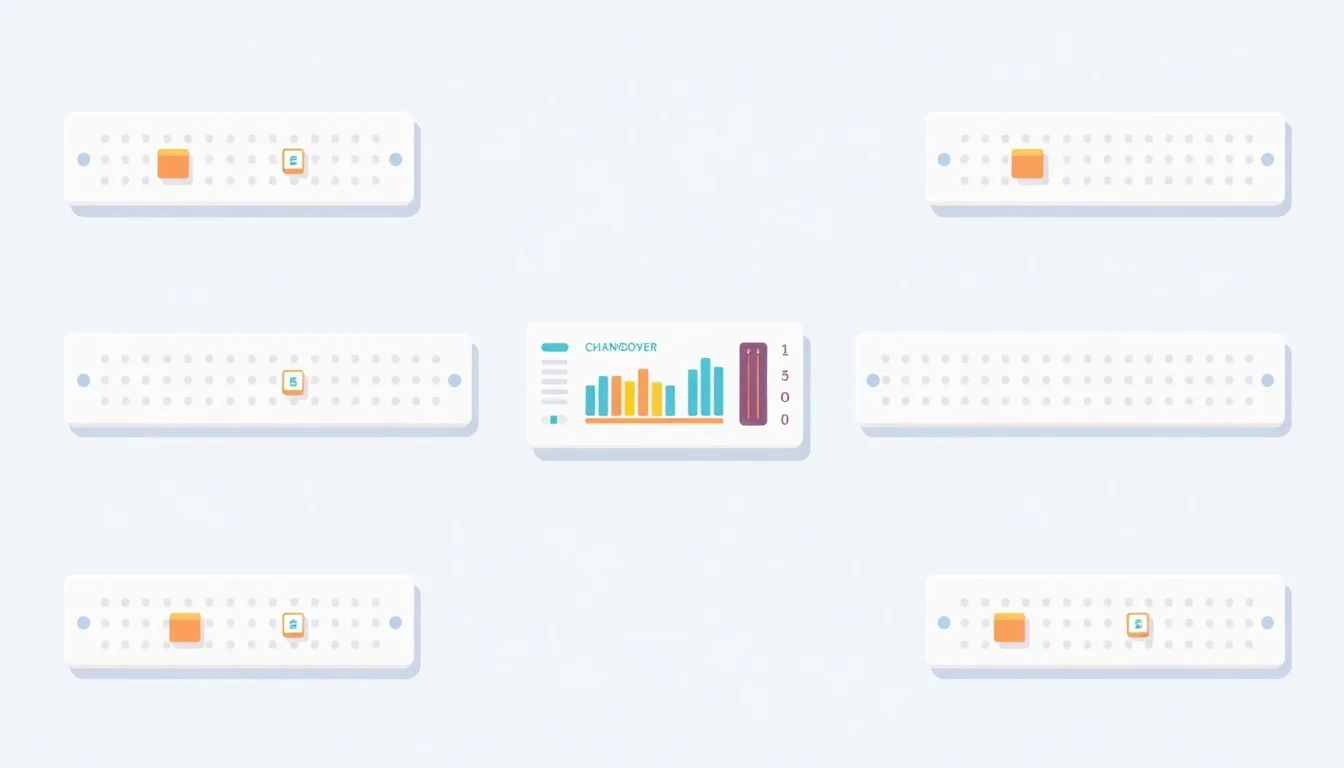
Managing 12 changeovers across 8 lines requires sequencing by product family, pre-staging all materials before the first changeover starts, and assigning dedicated changeover crews rather than pulling line operators. Real-time visibility into each line's readiness status is essential. Without it, delays cascade, labor costs spike, and supervisors are flying blind.
Managing 12 changeovers across 8 lines requires sequencing by product family, pre-staging all materials before the first changeover starts, and assigning dedicated changeover crews rather than pulling line operators. For example, consider a mid-market skincare contract manufacturer running 12 changeovers across 8 lines in a single shift. Line 3 feeds Lines 4 and 5, and a fragrance-to-unscented transition requires 45 minutes of regulatory verification plus sanitation, while a formulation-to-formulation swap on the same line takes only 20 minutes. By sequencing the longest-duration changeover (Line 3) first, pre-staging all materials and documentation 30 minutes before shift start, and deploying a dedicated 3-person changeover crew separate from line operators, the operation eliminated cascading delays that previously pushed the second set of changeovers into overtime and triggered quality escapes on downstream lines. Real-time visibility into each line's readiness status is essential. Without it, delays cascade, labor costs spike, and supervisors are flying blind.
Why High-Volume Changeover Days Break Traditional Line Management
Changeovers are the single largest controllable source of unplanned downtime in light manufacturing. That statement is not hyperbole. When you're running 12 changeover events across 8 lines in a single shift, the coordination complexity doesn't scale linearly. It compounds.
Traditional line management assumes a supervisor can hold the status of every line in their head and respond to problems as they surface. That model fails at scale. Supervisors become reactive firefighters. Decisions get made on gut feel. And the floor pays for it in idle labor, quality escapes, and overtime.
In beauty contract manufacturing specifically, each changeover isn't just a tooling swap. Formulation changes, packaging transitions, labeling updates, and sanitation requirements all stack on top of each other. A changeover that takes 20 minutes on a beverage line might take 45 minutes on a skincare line due to regulatory verification requirements alone. You cannot compress that step.
The Cascading Failure Pattern on Multi-Line Operations
One delayed changeover on a feeder line doesn't stay on that line. It hits the downstream packaging line, which then sits idle, which pulls labor from a third line to cover, which creates a gap that triggers a quality issue on a fourth. This is the domino pattern that turns a manageable morning into a crisis by 2 PM.
Quality escapes are most likely in the first 15 minutes after a changeover completes, when processes haven't stabilized and workers are still adjusting. If your supervisor is walking the floor to discover problems rather than receiving alerts, you've already lost that window.
The fix is not more supervisors. The fix is better information architecture.
The Hidden Labor Cost of Uncoordinated Changeovers
Workers standing idle during changeover transitions are fully loaded on your labor cost ledger. Every minute of idle time is paid time. Overtime triggered by delayed changeovers is the most expensive and most preventable labor cost in manufacturing. It's also the most politically charged, because nobody wants to be the person who called it wrong.
Most ERP and MES systems track machine downtime with reasonable accuracy. They do not capture workforce idle time during changeovers. That gap is a blind spot that makes labor cost per unit calculations systematically wrong. You're making pricing decisions, scheduling decisions, and staffing decisions on incomplete data.
At Elements Connect, we see this pattern consistently across mid-market manufacturers: the MES tells them a changeover took 35 minutes, but the workforce data tells a different story entirely, with 12 workers idle for 20 of those minutes while one person hunted for a missing component.
Pre-Changeover Planning: The Work That Happens Before the Whistle Blows
Pre-staging is the highest-leverage activity available to you. If every changeover has its materials, tooling, and documentation staged and verified before the first changeover of the day begins, you eliminate the largest single category of delay.
This requires a cultural shift as much as a process one. Pre-staging means someone owns that preparation, signs off on it, and is accountable for gaps. Not a team. A named individual.
Digital changeover readiness checklists connected to a workforce visibility platform allow you to see the readiness status of all 8 lines simultaneously, from one screen, without a single walkthrough. Incomplete readiness at T-minus 30 minutes is your leading indicator. Treat it as an early warning signal, not a nuisance.
Lean manufacturing research confirms that structured changeover reduction works. Implementing Lean Manufacturing philosophy decreased changeover time at the bottleneck process by 30% in 12 months (sciencedirect.com). That result came from systematic pre-staging, standard work documentation, and dedicated crew assignments, not from working faster.
Sequencing Logic for 8-Line Changeover Scheduling
Not all changeovers are equal. Group them by product family to minimize sanitation and tooling swap time between runs. A fragrance-to-fragrance transition is faster than a fragrance-to-unscented transition. An unscented-to-unscented run requires the least cleaning. Sequence with chemistry in mind, not just production order.
Prioritize lines with the longest changeover duration or highest downstream dependency first. If Line 3 feeds Lines 4 and 5, Line 3's changeover owns the morning. Build buffer time between sequenced changeovers on the same crew's rotation. Back-to-back scheduling without buffers doesn't feel aggressive; it guarantees overruns.
Regulatory and compliance verification time in personal care manufacturing cannot be compressed. Build it in as a fixed cost. Trying to skip or rush it is where quality escapes come from.
Building Your Changeover Readiness Checklist
Each changeover needs a verified checklist: materials staged, tooling confirmed, documentation ready, quality parameters posted at the line. Digital checklists beat binder-based systems. They create a timestamped record, they're searchable, and they feed performance data back into your production scheduling process.
Digital work instructions also solve a consistency problem that paper never could. When workers across different shifts and different lines follow the same digital standard work on a tablet at the line, you reduce the performance variance that makes changeover time estimates unreliable. Consistency is the precondition for improvement.
Real-Time Coordination Strategies During Active Changeover Windows
Assign one person as coordination authority for the full 12-changeover schedule. Not a committee. One person. They own the plan, they call the delays, and they make redeployment decisions. At this volume, distributed authority creates the ambiguity that slows everything down.
Color-coded visual management systems, whether on a physical board or a digital dashboard, reduce cognitive load on supervisors who would otherwise hold all of this in their heads. Green means on track. Yellow means at risk. Red means intervention needed. Supervisors should see that picture in real time, not reconstruct it from walkthroughs.
Deploying Labor Intelligently Across Simultaneous Changeovers
Cross-trained workers are the flexible resource that makes multi-line changeover management survivable. When a dedicated changeover crew member is pulled to handle a problem on Line 6, you need to replace that capability immediately with someone who can actually perform the task. Generic temp fulfillment doesn't work here.
Workforce cross-skilling reduces quality risk during simultaneous changeovers because it decouples execution quality from individual availability. A worker who is cross-trained on both filling and labeling changeover procedures can slot into either role without a quality dip. Without cross-training, every personnel gap is a potential quality event.
Labor deployment decisions during active changeovers should be driven by real-time availability and skill-match data, not supervisor memory. Staffing agencies supplying temp labor need to provide worker skill profiles mapped to specific changeover tasks. If your staffing partner can't tell you which of their workers has completed changeover training on your Line 2 filling equipment, you have an execution risk problem that will show up in your changeover data.
Communication Infrastructure for High-Volume Changeover Days
Define a single communication channel for changeover status updates before the day starts. Radio, digital alert, platform notification. Pick one and enforce it. Mixed channels create the information fragmentation that turns small problems into large ones.
Establish time checkpoints: 15-minute warning before changeover start, confirmation when changeover begins, notification when first-unit quality check clears. Post-changeover first-run quality verification should be built into the communication loop, not treated as a separate workflow that happens later when someone gets around to it.
Supervisors should receive push notifications on line status deviations rather than having to discover problems during floor walks. The floor walk model doesn't scale across 8 lines. By the time you've walked all 8, the first 3 have changed status.
Measuring Changeover Performance Across Multiple Lines
If you're not measuring changeover time, you're not managing it. You're surviving it. Measurement is not optional at this scale.
The metrics that matter: planned versus actual changeover duration, first-run quality yield post-changeover, and labor hours consumed per changeover event. These three numbers, tracked by line, by crew, and by product transition type, will show you exactly where your system is failing and why.
Overall Labor Effectiveness (OLE) frameworks should incorporate changeover performance as a core input, not an afterthought. Most OLE implementations focus on availability, performance rate, and quality yield at the machine level. The workforce variable, including idle time during changeovers, is typically missing. That omission makes OLE calculations optimistic.
The Metrics That Actually Predict Changeover Success
Readiness completion rate at T-minus 30 minutes is the leading indicator that predicts whether a changeover will run on time. It's measurable before the changeover starts. That's the point. By the time you're measuring actual changeover duration, you've already either succeeded or failed based on preparation.
First-unit pass rate post-changeover measures whether the transition was executed correctly, not just quickly. A fast changeover that produces 200 rejects is not a successful changeover. Labor utilization during changeover, specifically the ratio of active to idle time, identifies waste that is completely invisible without workforce tracking.
Changeover overrun frequency by line, crew, and product type reveals patterns. If Line 4 consistently overruns when switching between two specific SKUs, and a specific crew is always involved, that's a training opportunity, not a discipline issue. The data makes the distinction.
Connecting Changeover Data to Labor Cost Intelligence
Here's the calculation most operations teams never run: changeover duration multiplied by labor headcount multiplied by blended hourly rate equals true changeover labor cost. Run that number for each of your 12 changeovers today. The result will change how you prioritize improvement investments.
Workforce intelligence platforms that integrate with ERP and MES can automate this calculation in real time, giving you cost-per-changeover data as it accumulates. For beauty contract manufacturers, this data is critical for client-level profitability analysis and contract pricing negotiations. If you don't know what a changeover actually costs, you can't price it correctly.
Building a Repeatable Changeover System That Scales With Your Operation
A changeover system that works for 12 events today must be designed to handle 20 tomorrow without proportional increase in supervisory overhead. That scalability comes from standard work, cross-training, and technology integration, not from hiring more supervisors.
SMED (Single-Minute Exchange of Die) methodology is the most documented framework for systematic changeover time reduction. The implementation timeline for a genuine SMED program in a high-SKU environment typically runs 6 to 12 months for meaningful results. Lean manufacturing data supports a 30% changeover time reduction at the bottleneck process over 12 months (sciencedirect.com). The failure modes are predictable: incomplete separation of internal versus external work, lack of management support for the buffer time required, and failure to update standard work documentation as the process improves. SMED without documentation is just a one-time event.
Standard Work Documentation for Changeover Repeatability
Each changeover type should have a documented standard: sequence of steps, time targets, required skill level, and quality checkpoints. This documentation reduces reliance on institutional knowledge held by a few experienced workers, which is a major risk in high-turnover manufacturing environments.
Kaizen-based continuous improvement applied specifically to changeover processes compounds efficiency gains over time. The mechanism is simple: each changeover generates performance data, that data informs updates to standard work, updated standard work produces better performance, which generates better data. The loop only works if standard work documentation is treated as a living document rather than a historical artifact.
Digital standard work accessible on tablets at the line consistently outperforms binder-based systems for compliance. Workers follow instructions they can see clearly at the point of execution.
Technology Stack for Multi-Line Changeover Intelligence
The practical technology stack for multi-line changeover management connects three systems: scheduling (ERP), production status (MES), and workforce deployment (workforce intelligence platform). Most mid-market manufacturers have the first two. The third is where the gap is.
IoT-based timestamps, which automatically capture line stop time and first good product time, eliminate manual recording errors and give you accurate changeover duration data without relying on workers to log start and end times. The integration challenge is real. IoT sensors feed data in formats that don't always map cleanly to ERP or MES schemas. Cloud and hybrid platform deployments for single-site integrations typically take 4 to 8 weeks when the data architecture is planned properly in advance. That timeline extends when data quality issues are discovered mid-implementation, which is common. Addressing messy or siloed data before deployment, not during it, is the step most teams skip.
AI-driven scheduling tools are being adopted across mid-market manufacturing, though independent ROI data remains limited. What the practical implementations show is that AI scheduling works well for optimization within defined constraints, but requires clean, structured input data to function. The organizations seeing the most benefit are those that standardized their changeover data collection first, then applied AI on top of a clean data foundation. The sequencing matters. AI on top of poor data produces confident wrong answers.
Real-time dashboards showing all 8 lines' changeover status, labor deployment, and readiness scores give operations leaders the ground-level control they need to manage by exception rather than by constant floor presence. That shift, from reactive to proactive coordination, is where the throughput gains actually live.
Frequently Asked Questions
What is the fastest way to reduce changeover time when managing multiple production lines simultaneously?
How many workers should be assigned to a dedicated changeover crew versus staying on the production line?
What metrics should I track to measure changeover performance across 8 or more lines?
How do I prevent a delay on one line from cascading into disruptions on other lines during high-volume changeover days?
What's the difference between SMED and standard changeover management, and which is right for a high-SKU beauty contract manufacturer?
How can I calculate the true labor cost of each changeover event across my production lines?
Why do my ERP and MES systems fail to capture changeover performance data, and how do I fix that gap?
How do I manage changeover execution when I'm relying heavily on temp or agency labor with inconsistent skill levels?
Sources & References
About the Author
Elements Connect
Elements Connect is a workforce intelligence platform helping beauty contract manufacturers, 3PLs, and staffing agencies transform disconnected labor data into actionable insights that reduce costs and elevate operational performance.
Learn more at elementsconnect.com → (opens in a new tab)Related Posts

How Staffing Agencies Can Build a Proprietary Talent Quality Score Clients Can't Get Anywhere Else
Most staffing agencies compete on price and speed—but neither creates lasting client loyalty. A proprietary Talent Quality Score built from real performance data changes the conversation entirely. Here's the step-by-step framework for building one your clients can't find anywhere else.
10 min read
Your Best Operators Are Carrying Your Worst Ones: How to Use Per-Worker Performance Data to Fix Line Imbalance
When your fastest operators compensate for your slowest ones, line imbalance becomes invisible—until it shows up in your labor cost per unit. This guide shows plant managers and operations leaders how to use per-worker performance data to surface hidden imbalance, reassign talent strategically, and build a continuous improvement culture that scales.
15 min read
Why Display Manufacturers Keep Getting Labor Wrong (It's Not What You Think)
Display manufacturers consistently mismanage labor for one structural reason: every tool they have was built for a different kind of factory.
4 min read