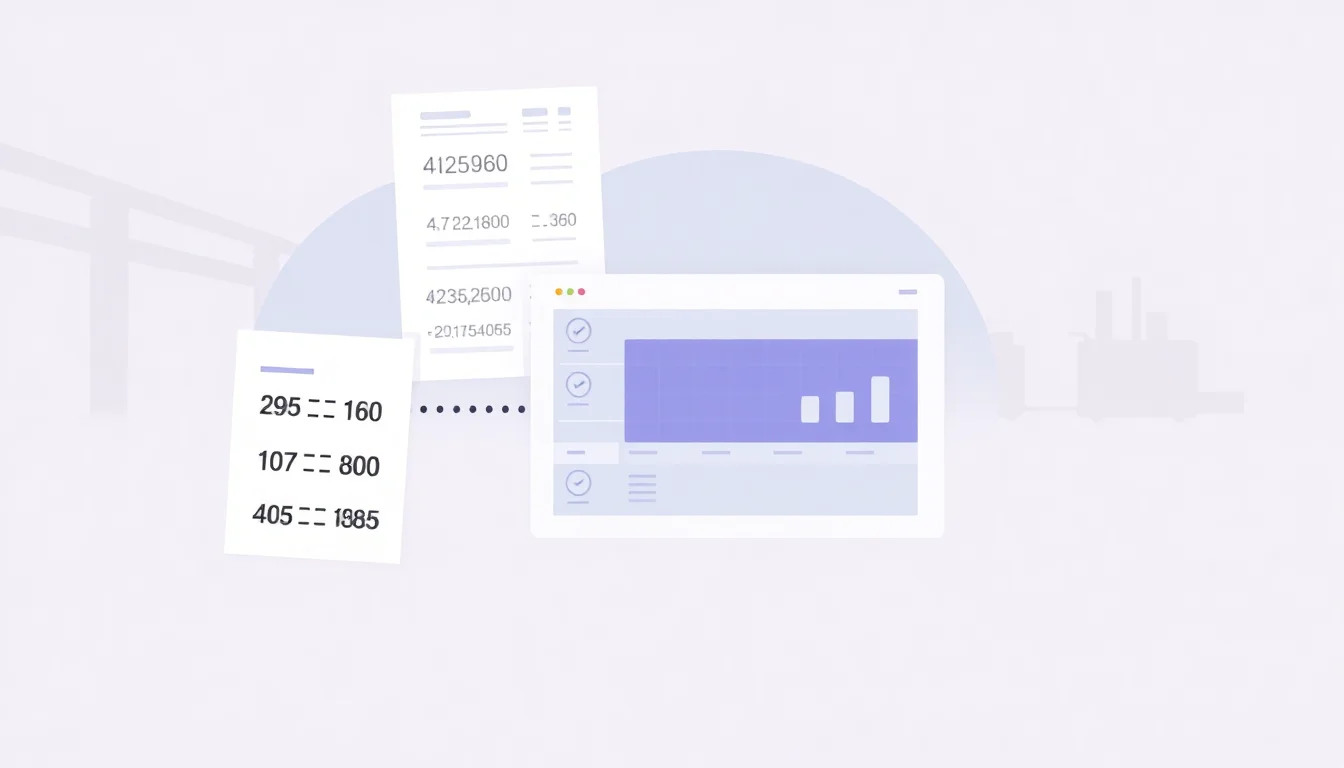
Three Sets of Records, Three Different Numbers: Solving the Timesheet Reconciliation Nightmare in Manufacturing
Timesheet reconciliation produces different numbers across systems because each source captures labor hours using different rules, time boundaries, and data entry methods. Staffing agencies bill portal-to-clock, ERP tracks shift schedules, and supervisors log actual floor time. Eliminating the gap requires a single authoritative time source integrated directly into payroll, production, and staffing records.
Timesheet reconciliation produces different numbers across systems because each source captures labor hours using different rules, time boundaries, and data entry methods. Staffing agencies bill portal-to-clock, ERP tracks shift schedules, and supervisors log actual floor time. Eliminating the gap requires a single authoritative time source integrated directly into payroll, production, and staffing records. At Elements Connect, we recommend this integrated approach because it eliminates the manual reconciliation work that consumes hours of administrative time every pay period.
Published: June 2025 | Last Updated: June 2025
When your staffing agency shows 847 hours, your ERP shows 803, and your floor supervisors counted 821, someone is wrong. You just don't know who. That uncertainty is not a minor inconvenience. It is a structural problem that quietly erodes margins, creates compliance exposure, and consumes hours of administrative time every pay period. This guide breaks down exactly why the numbers diverge and how to permanently close the gap.
Why Three Systems Produce Three Different Numbers
Every system in your labor stack was built with a different primary objective. Agency portals are built to protect billing accuracy. ERP systems are built around production schedules. Supervisor logs are built for shift management. None of them were designed to agree with each other.
The result: each system applies its own definition of a "worked hour." A worker who badges in at 6:58 AM may be recorded as clocking in at 7:00 AM by the agency (rounding to the nearest quarter-hour), as starting at 6:30 AM by the ERP (because that is the scheduled shift start), and as arriving at 6:55 AM by the supervisor (because that is when the team briefing began). One worker, one shift, three numbers.
Manual timesheet entry compounds this. The data is clear. Manual entry is not a minor risk factor. It is a systematic one.
Payroll mistakes have real workforce consequences. Research shows that 53% of workers report turnover risk after experiencing payroll errors (hrmorning.com). For operations dependent on temp labor quality and retention, that number should reset how seriously reconciliation accuracy is treated.
The Staffing Agency Billing Gap
Agency timesheets are designed to maximize billing accuracy for the agency, not to mirror your facility's operational definitions. Workers clock in through agency portals running on independent servers, often with no connection to your facility's badge readers or time-and-attendance hardware.
Rounding rules are a persistent, underappreciated source of divergence. If your facility rounds to the nearest six minutes and the agency rounds to the nearest quarter-hour, every shift will produce a small gap. Across a workforce of 150 temp workers over a 26-pay-period year, those small gaps accumulate into real dollar exposure.
Agencies may also include pre-shift orientation, safety briefings, or travel-between-workstation time that your ERP excludes from productive labor hours entirely. Neither treatment is necessarily wrong. They are just different, and the difference shows up every time you try to reconcile an invoice.
The ERP Scheduled-vs-Actual Problem
Most ERP and MES platforms are built around planned production schedules. They know what was supposed to happen. They do not reliably know what actually happened on the floor.
When a line goes down for a changeover, workers on standby are still present and still paid. Production records track output or project time, which may exclude non-productive hours like downtime standby, cleaning rotations, or equipment changeovers. Those hours are real labor costs. They simply do not appear in the ERP labor ledger unless someone manually enters them, which introduces its own error rate.
Break time mishandling is another depth problem most guides skip. If your ERP deducts a fixed 30-minute break regardless of whether workers took a shorter break during a peak period, every such shift will show fewer hours in the ERP than in reality. Overtime mishandling works similarly. If a system applies FLSA daily overtime thresholds correctly but a staffing agency applies only weekly thresholds, the same worker's hours will appear in different pay categories across the two systems, creating a discrepancy that looks like an error but is actually a policy disagreement.
Without a direct integration between a physical time clock and the ERP labor module, ERP labor data is an estimate. Call it what it is.
The Real Cost of Unreconciled Timesheets
Unreconciled timesheets have three distinct cost categories: financial, compliance, and operational.
Financially, payroll overpayments and underpayments are the most visible impact. But the less visible cost is the administrative time consumed by reconciliation itself. Finance and payroll teams in mid-market manufacturing operations regularly spend multiple full workdays per pay period manually comparing spreadsheets, chasing supervisor corrections, and disputing agency invoices. That time has a salary cost, and it produces no output.
Disagreements over hours also delay invoice payment cycles. When you cannot reconcile an agency invoice to your internal records, you withhold payment pending resolution. Staffing partners operating on thin margins notice that quickly. The vendor relationship degrades, and with it, your priority access to quality temp labor during peak seasons.
Hidden Margin Erosion in Contract Manufacturing
Beauty contract manufacturers are particularly exposed. Operating on tight margins, there is limited room to absorb labor cost inflation from reconciliation errors. When billed agency hours consistently exceed recorded productive hours, the gap comes directly out of margin.
The deeper problem is that inaccurate labor-to-output ratios make it impossible to calculate true labor cost per unit, which is the most actionable metric for operations leaders trying to price contracts, benchmark shift performance, or identify underperforming lines. Without clean data, cost reduction initiatives tend to target equipment and materials because those numbers are visible. Labor waste goes unaddressed because the data required to see it does not exist.
This is also where overall labor effectiveness calculations break down. OLE requires accurate hours as an input. Feed it bad data and the metric becomes decoration, not intelligence.
Root Cause Diagnosis: Finding Where Your Numbers Diverge
Before attempting any fixes, you need to know what kind of problem you have. Not all discrepancies are created equal, and the remediation for a systematic rounding rule difference is completely different from the remediation for missed punches.
Start with a structured three-way reconciliation audit for one pay period. Do not start with the aggregate totals. Aggregate numbers can mask offsetting errors, where a worker who was overpaid by two hours offsets a worker who was underpaid by two hours, making the totals appear to reconcile while the individual records are both wrong.
The Three-Way Reconciliation Audit Method
Export one week of industry research, date, total hours, and pay category. Use a pivot table to surface individual discrepancies at the worker-day level. Flag any discrepancy above 0.25 hours per worker per day for investigation.
For each flagged record, categorize the discrepancy: rounding error, missing punch, retroactive edit, system cutoff mismatch, or misclassified labor type. This categorization step is where most operations skip ahead too fast. The pattern across categories tells you where to invest in fixes.
Check specifically for retroactive timesheet edits in each system. Systems that allow back-editing without audit trails are major reconciliation liabilities. A supervisor who corrects last Tuesday's records on Friday afternoon creates a gap that can never be explained through normal reconciliation unless that edit is timestamped and logged.
Systematic vs. Random Discrepancies
Systematic discrepancies appear consistently in the same direction. The agency always shows more hours than your ERP. The ERP always shows fewer hours than supervisor logs. These patterns indicate a structural rule difference, and they require a structural fix: changing the rounding rule, aligning cutoff times, or reclassifying how indirect labor is recorded.
Random discrepancies appear unpredictably across workers and shifts. These indicate process failures: missed punches, supervisor overrides without documentation, or manual corrections entered into only one system. Fixing random discrepancies requires process controls and automated exception alerts, not rule changes.
Most operations have both types running simultaneously. Treating them as the same problem wastes time. Separate the remediation tracks from the start.
Data syncing issues deserve more technical attention than most vendor guides provide. Clock synchronization failures between facility badge hardware and agency portal servers create timestamp discrepancies that compound across large workforces. A five-minute drift between two system clocks means that a worker who clocks out at 3:00:00 PM in your system clocks out at 2:55:00 PM in the agency's system. Across 200 workers over 10 shifts, that five-minute drift generates a meaningful aggregate discrepancy that looks exactly like fraud or error but is actually a server configuration issue. IT and HR need to audit system clock alignment as part of any reconciliation investigation.
How to Build a Single Source of Truth for Labor Hours
The solution is architectural, not procedural. You cannot reconcile your way out of a structural data problem by adding more reconciliation steps. You resolve it by designating one system as the authoritative record and integrating everything else from it.
For most facility-based operations, the authoritative record should be a facility-controlled time-and-attendance system using biometric or badge-based hardware at entry points. Last month, the agency invoiced 3,240 hours, the ERP showed 3,087 hours, and supervisor logs recorded 3,156 hours. The 153-hour discrepancy cost $2,295 in disputed charges and consumed 12 hours of finance team time in reconciliation spreadsheets (hrmorning.com). This eliminates the primary source of dispute: whose clock-in record is correct. When both the employer and the agency are reading from the same physical time collection event, the billing gap cannot exist.
At Elements Connect, we have seen operations reduce their reconciliation workload dramatically simply by requiring staffing partners to use facility hardware as the input for invoicing. The agency still manages its workers and generates its invoices. It just does so using time data that originates from a source both parties accept as neutral.
Technology Requirements for Reconciliation-Free Operations
Real-time data syncing minimizes errors in ways that batch processing cannot. When a time event is captured at a badge reader and immediately pushed to both the payroll system and the production labor record, there is no window in which a manual re-entry error can occur. The event happens once and propagates automatically.
A workforce intelligence platform that connects time data to production output gives managers context beyond raw hours. Knowing that Line 3 logged 840 labor hours last week is less useful than knowing it produced 14,200 units at a labor cost of $X per unit with a specific staffing source contributing a measurable portion of that output. That level of visibility turns reconciled time data into shift performance metrics that actually drive decisions.
Platforms that integrate with existing MES and ERP systems via API, without requiring a full rip-and-replace, are the practical choice for operations with existing infrastructure investments. ERP labor integration should be an addition, not a replacement. The goal is to feed clean, authoritative hours into the systems that already exist, not to build a parallel data universe.
Staffing Agency Alignment: Contractual and Operational Steps
Technology alone is not sufficient. Contractual alignment with staffing partners is equally necessary. Add a timesheet data standard clause to agency contracts: invoicing must reconcile to facility-recorded hours within a defined tolerance per worker per week. Require worker-level hour detail with every invoice. Aggregate totals are insufficient for reconciliation and should not be accepted.
Establish a joint reconciliation meeting cadence with staffing partners, weekly during peak seasons, bi-weekly during baseline periods. Agencies that provide staffing agency performance data alongside hours, including attendance rates, quality metrics, and productivity per worker, transition from transactional vendors to operational partners. That distinction matters when you need to scale quickly.
FLSA compliance adds a non-negotiable dimension to this entire conversation. The Fair Labor Standards Act requires employers to maintain accurate records of hours worked, including overtime. When your payroll records and timesheets cannot be reconciled to a single authoritative source, you cannot demonstrate compliance in an audit. Payroll compliance in manufacturing is not just an operational concern. It is a legal one, and the penalties for wage and hour violations scale with the number of affected workers and the duration of the non-compliance.
Sustaining Reconciliation Accuracy: Ongoing Processes and Governance
Building a single source of truth is a project. Sustaining it is a discipline.
Assign explicit ownership. When everyone is responsible for timesheet reconciliation, no one is. A named role with accountability for reconciliation accuracy is the single most effective governance step most operations skip.
Run a lightweight reconciliation check every week, not just at pay period close. Catching a discrepancy on day three of a pay period costs a conversation. Catching it after payroll closes costs a correction cycle, potential compliance exposure, and a frustrated worker. Early detection is dramatically cheaper.
Publish a reconciliation scorecard monthly: total discrepancy hours, dollar value, root cause breakdown, and trend direction. Make it visible to operations leaders, not just payroll staff. Build timesheet accuracy into supervisor performance reviews as a measured KPI. Supervisors who own the accuracy of their team's time records are supervisors who create accountability on the floor.
Turning Reconciliation Data into Operational Intelligence
Clean labor data is not just a reconciliation outcome. It is a strategic input. Once hours are accurate, you can calculate true labor cost per unit by line, by shift, by staffing source. You can identify which temp labor management partners deliver the best output per billed hour. You can build an evidence-based preferred supplier list that rewards performance rather than just price.
Accurate labor data fed into capacity planning models allows operations to right-size workforce to seasonal demand without the chronic overstaffing or missed SLAs that come from working off inconsistent numbers. The reconciliation problem feels like a back-office headache. Solve it, and it becomes a competitive advantage.
Frequently Asked Questions
Why do my staffing agency hours never match what my ERP shows?
What is the legal risk if my payroll records and timesheets don't reconcile?
How long does it take to fix a timesheet reconciliation problem across multiple systems?
Can I require my staffing agency to use my facility's time clock instead of their portal?
What's the difference between a timesheet discrepancy and a payroll error?
How do I calculate how much timesheet reconciliation errors are costing my operation?
What technology integrations are needed to eliminate manual timesheet reconciliation?
How do other contract manufacturers handle reconciliation across multiple staffing vendors?
Sources & References
About the Author
Elements Connect
Elements Connect is a workforce intelligence platform helping beauty contract manufacturers, 3PLs, and staffing agencies transform disconnected labor data into actionable insights that reduce costs and elevate operational performance.
Learn more at elementsconnect.com → (opens in a new tab)Related Posts

How Staffing Agencies Can Build a Proprietary Talent Quality Score Clients Can't Get Anywhere Else
Most staffing agencies compete on price and speed—but neither creates lasting client loyalty. A proprietary Talent Quality Score built from real performance data changes the conversation entirely. Here's the step-by-step framework for building one your clients can't find anywhere else.
10 min read
Your Best Operators Are Carrying Your Worst Ones: How to Use Per-Worker Performance Data to Fix Line Imbalance
When your fastest operators compensate for your slowest ones, line imbalance becomes invisible—until it shows up in your labor cost per unit. This guide shows plant managers and operations leaders how to use per-worker performance data to surface hidden imbalance, reassign talent strategically, and build a continuous improvement culture that scales.
15 min read
Why Display Manufacturers Keep Getting Labor Wrong (It's Not What You Think)
Display manufacturers consistently mismanage labor for one structural reason: every tool they have was built for a different kind of factory.
4 min read