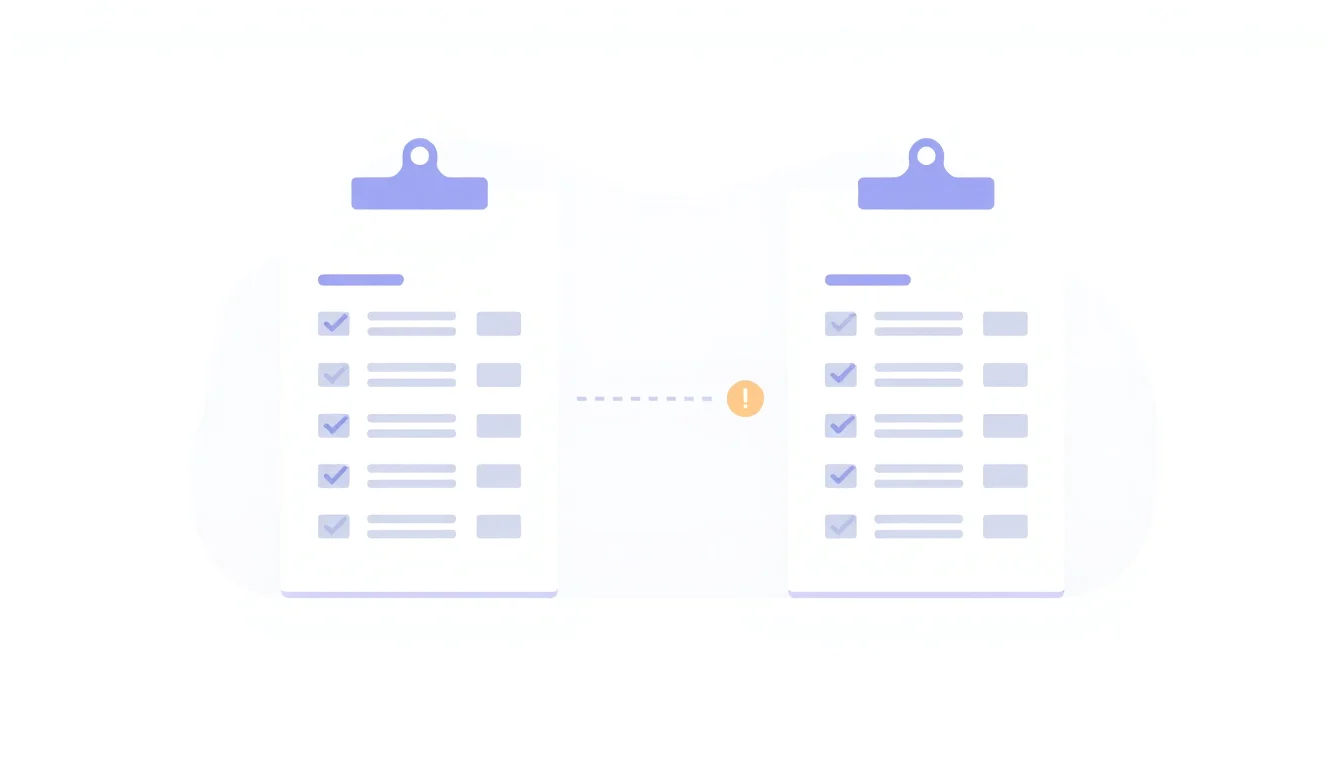
When your staffing agency invoice doesn't match your records, start by comparing timesheets, bill rates, and markup percentages line by line against your internal logs. Identify whether the gap is a data entry error, a rate discrepancy, or a systemic tracking failure. Document every variance, escalate to your agency contact, and request a corrected invoice with supporting detail.
Common Reasons Staffing Agency Invoices Don't Match Internal Records
Invoice mismatches rarely happen for one reason. They stack. Bill rate errors, timesheet gaps, and classification changes combine to create variances that grow larger with every billing cycle.
Billing errors are more prevalent than most operations leaders realize. In industrial staffing, billing errors (17%) rank among the documented reasons companies end agency relationships (everee.com). And poor billing practices overall are cited by 26% of respondents as a reason for ending partnerships entirely (pymnts.com).
Here are the most common root causes:
- Bill rate errors occur when agencies apply outdated or incorrect pay-to-bill markups, especially after contract renewals
- Timesheet gaps emerge when workers clock in via your facility system but report hours separately to agency supervisors, creating two competing records
- Shift differentials and overtime premiums are frequently applied inconsistently, especially when agencies don't receive shift-level data from your floor
- Worker classification changes from standard to skilled labor tiers may never reach your finance team
- Duplicate billing happens when agencies invoice workers already covered under a separate purchase order
- Manual timesheet collection creates transcription errors that compound across weekly billing cycles
Mismanagement of contingent labor can drain 15-30% of a company's total talent budget (buraqhr.com). For a facility spending $2 million annually on temp workers, that's a potential loss of $300,000-$600,000 per year (buraqhr.com). The stakes are real.
Timesheet Data Disconnects: The Root Cause Most Teams Miss
Agencies bill based on approved or submitted data that often differs from raw internal records. This is the gap most teams overlook.
Workers badge into your facility system. Then they separately report hours to an agency supervisor. Two records. One worker. The numbers rarely match exactly.
Without a unified data layer connecting facility timekeeping to agency reporting, finance teams reconcile manually. Manual reconciliation introduces errors. It also delays dispute resolution by days or weeks, long after payment windows have closed.
Three-way matching, comparing your internal records, the agency timesheet, and the originating work order or PO, is the most reliable method for catching these disconnects early. But it only works if all three data sources are accessible and structured consistently.
Rate and Markup Discrepancies Hiding in Plain Sight
Staffing contracts frequently include tiered bill rates for different job classifications. Applying the wrong tier is easy when agencies handle dozens of clients and multiple rate schedules.
Markup percentages may vary by department, shift, or season. Agencies don't always communicate mid-cycle changes. Your finance team processes the invoice assuming last quarter's rates still apply. They may not.
Review your master services agreement line by line against every invoice. Confirm that each rate matches the current contract period and the specific job code being billed.
Step-by-Step Staffing Invoice Reconciliation Process
A disciplined reconciliation process turns a chaotic dispute into a documented, resolvable business transaction. Follow these steps in order.
Step 1: Pull your internal timekeeping records for the exact invoice period before contacting the agency. Do not rely on memory or summary reports.
Step 2: Build a side-by-side comparison mapping each worker, hours logged, job code, and applied bill rate. A spreadsheet works. A workforce data reconciliation platform works better.
Step 3: Flag every line item where hours, rates, or worker classifications differ from your records.
Step 4: Calculate the total dollar value of each variance. Prioritize disputes by financial impact, not by which discrepancy is easiest to explain.
Step 5: Request the agency's supporting documentation. Original timesheets. Supervisor approvals. Rate schedule confirmation for the billing period.
Step 6: Submit a formal dispute in writing with your variance summary. Hold payment on contested amounts per your contract terms. Do not release funds on disputed line items.
Step 7: Agree on a corrected invoice or credit memo in writing before releasing any held payment.
Enforcing a weekly or bi-weekly "chase cadence" for missing timesheet data, rather than waiting for month-end, catches variances while they're still small and easy to resolve.
How to Document Variances So Disputes Get Resolved Faster
Structured documentation shortens dispute timelines. Use a variance log that captures these fields for every discrepancy:
- Worker ID
- Shift date
- Hours per your records vs. hours per invoice
- Rate applied vs. rate on contract
- Net dollar difference
Attach timestamped badging records or supervisor sign-off sheets as primary evidence. Send dispute documentation via email. Always. Email creates a timestamped paper trail that protects you if the dispute escalates beyond your account manager.
What to Do When the Agency Pushes Back on Your Dispute
Pushback is common. It does not mean you're wrong.
Reference the specific clause in your staffing agreement that governs dispute resolution timelines and escalation paths. Request a joint review call with your agency account manager and their billing team within 5 business days of the pushback.
If disputes are chronic, escalate to a formal contract performance review. Invoke your audit rights if your agreement includes them. That clause exists for exactly this situation.
How Disconnected Systems Create Chronic Invoice Mismatches
This is a systems problem as much as a process problem.
Most facilities run three or more separate systems for workforce data: a facility badging or timekeeping system, an agency portal, and an ERP or financial system. These systems rarely share data in real time. Every invoice cycle requires manual reconciliation. Manual reconciliation introduces error.
A striking 56% of companies lack visibility into their contingent workforce (papayaglobal.com). That's more than half of all organizations operating without a clear picture of their temp labor spend until the invoice arrives.
MES and ERP platforms are built to track materials and machine output. They are not built to capture contingent labor hours at the worker level. Staffing agencies maintain their own timekeeping infrastructure. That creates a second authoritative source of truth that competes with yours. When the two sources conflict, you get a dispute.
Staffing agencies also operate on a negative cash cycle, fronting labor costs before receiving client payment. That cash pressure sometimes accelerates billing before all hours are fully reconciled on the agency side, creating invoice errors that aren't intentional but are still your problem to catch.
The Hidden Cost of Manual Reconciliation at Scale
Errors caught after payment is released are significantly harder and more expensive to recover than disputes filed before payment. Recovery requires credit memos, renegotiation, and often goodwill from an agency relationship that's already under strain.
At facilities using multiple staffing agencies across multiple shifts, manual reconciliation compounds in complexity. Consider a plant running 3 agencies across 2 shifts, 5 days per week. That's potentially dozens of separate worker records to cross-check every billing cycle, by hand.
Greater visibility into contingent workforce spend helps procurement teams save up to 30% (papayaglobal.com). That number becomes believable the moment you calculate what your team currently spends on manual ERP timekeeping integration and dispute resolution.
Preventing Future Staffing Invoice Mismatches with Better Data Infrastructure
Fix the process. Then fix the infrastructure. Both matter.
Start with these structural changes:
- Require agencies to submit worker-level timesheets, not just aggregate hours, with every invoice
- Implement weekly or bi-weekly micro-reconciliations instead of catching all variances at month-end
- Define clear data standards in your staffing contracts: job classification codes, rate tables, overtime triggers, and billing cutoff timelines
- Build a staffing agency scorecard that includes billing accuracy as a measurable performance metric alongside fill rate and retention
- Use a workforce intelligence platform to automatically flag hours, rates, or headcount that fall outside expected parameters before an invoice is processed
Organizations with agile contingent workforce programs achieve 2.5x greater annual revenue growth than their peers (beeline.com). The operational discipline that prevents invoice mismatches is the same discipline that enables workforce agility at scale.
At Elements Connect, we've seen operations teams eliminate the bulk of their reconciliation disputes simply by establishing a single source of truth for contingent labor hours and tying that data directly to production output tracking. The invoicing disputes don't disappear overnight, but they become detectable in real time rather than weeks after the fact.
Contract Clauses That Reduce Invoice Disputes Before They Start
Negotiate these terms into every staffing agreement before signing:
- Billing accuracy SLA: Agencies must issue corrected invoices within 5-10 business days of a dispute notice
- Audit rights clause: You have the right to inspect agency timekeeping records for any billing period
- Rate change notification: Overtime triggers, shift differentials, and worker reclassifications must be communicated in writing before they appear on an invoice
These clauses shift the accountability burden to the agency and give you contractual leverage when disputes escalate. Staffing contract compliance is not optional. It's a margin protection tool.
Using Workforce Intelligence to Close the Visibility Gap
Workforce intelligence platforms connect facility-level labor data, hours, output, and job codes, directly to invoicing workflows. The manual comparison step disappears.
Real-time dashboards surface discrepancies between scheduled hours, actual hours worked, and billed hours as they happen. Not weeks later. When labor performance data ties directly to production output, operations leaders can validate staffing costs against actual throughput rather than just hours logged.
This is the foundation of genuine labor cost visibility. And it's what separates facilities that manage staffing agency performance proactively from those that dispute invoices reactively.
When to Escalate a Staffing Invoice Dispute Beyond Your Account Manager
Know your escalation triggers. Act on them.
Escalate when:
- The same billing error recurs across two or more consecutive invoice periods after formal dispute
- The cumulative dollar value of unresolved disputes exceeds your contract's informal resolution threshold
- Billing accuracy falls below an acceptable benchmark across quarterly business reviews
- The agency cannot produce supporting documentation within a reasonable window
If your agreement includes a cure notice provision, use it. A cure notice is a formal written warning that continued billing errors may trigger contract termination. It signals seriousness and often produces faster resolution than account manager calls alone.
Evaluate whether the agency relationship should continue if disputes are frequent, slow to resolve, and not backed by transparent data. Billing accuracy is a performance metric. Treat it as one.
Building a Staffing Agency Accountability Framework
Formalize a quarterly business review process with each staffing partner. Include billing accuracy, fill rates, worker retention, and quality metrics in every review.
Share your variance logs with agency account managers as part of these reviews. Mutual accountability requires shared data. Agencies that see their billing error rate tracked alongside their fill rate respond differently than agencies that only receive ad hoc dispute emails.
Use performance data to differentiate between agencies that deliver consistent, accurate billing and those that don't. Allocate headcount orders accordingly. Staffing agency performance is a lever you control. Use it.
Frequently Asked Questions
How long does a staffing agency have to correct a billing error after a dispute is filed?
Can I withhold payment on a staffing invoice while a dispute is under review?
What documentation do I need to successfully dispute a staffing agency overbilling?
Why do staffing agencies and facilities end up with different hour counts for the same workers?
How do I calculate the total financial impact of a staffing invoice mismatch?
What contract terms should I negotiate to reduce staffing invoice disputes in the future?
Is it common for staffing agencies to overbill manufacturing facilities, and by how much?
How can workforce intelligence software prevent staffing invoice mismatches from happening?
Sources & References
- A Practical Guide to Maximizing Contingent Workforce Performance ROI (opens in a new tab)[industry]
- Why 56% Of Companies Lack Visibility Into Their Contingent Workforce (opens in a new tab)[industry]
- Industrial Staffing Report: How Agencies Win (or Lose) in 2025 (opens in a new tab)[industry]
- For 86% of Firms, Nearly a Third of Invoiced Sales Are Late (opens in a new tab)[industry]
- The Hidden Financial Drain Most Growing Companies Ignore (opens in a new tab)[industry]
About the Author
Elements Connect
Elements Connect is a workforce intelligence platform helping beauty contract manufacturers, 3PLs, and staffing agencies transform disconnected labor data into actionable insights that reduce costs and elevate operational performance.
Learn more at elementsconnect.com → (opens in a new tab)Related Posts

How Staffing Agencies Can Build a Proprietary Talent Quality Score Clients Can't Get Anywhere Else
Most staffing agencies compete on price and speed—but neither creates lasting client loyalty. A proprietary Talent Quality Score built from real performance data changes the conversation entirely. Here's the step-by-step framework for building one your clients can't find anywhere else.
10 min read
Your Best Operators Are Carrying Your Worst Ones: How to Use Per-Worker Performance Data to Fix Line Imbalance
When your fastest operators compensate for your slowest ones, line imbalance becomes invisible—until it shows up in your labor cost per unit. This guide shows plant managers and operations leaders how to use per-worker performance data to surface hidden imbalance, reassign talent strategically, and build a continuous improvement culture that scales.
15 min read
Why Display Manufacturers Keep Getting Labor Wrong (It's Not What You Think)
Display manufacturers consistently mismanage labor for one structural reason: every tool they have was built for a different kind of factory.
4 min read